






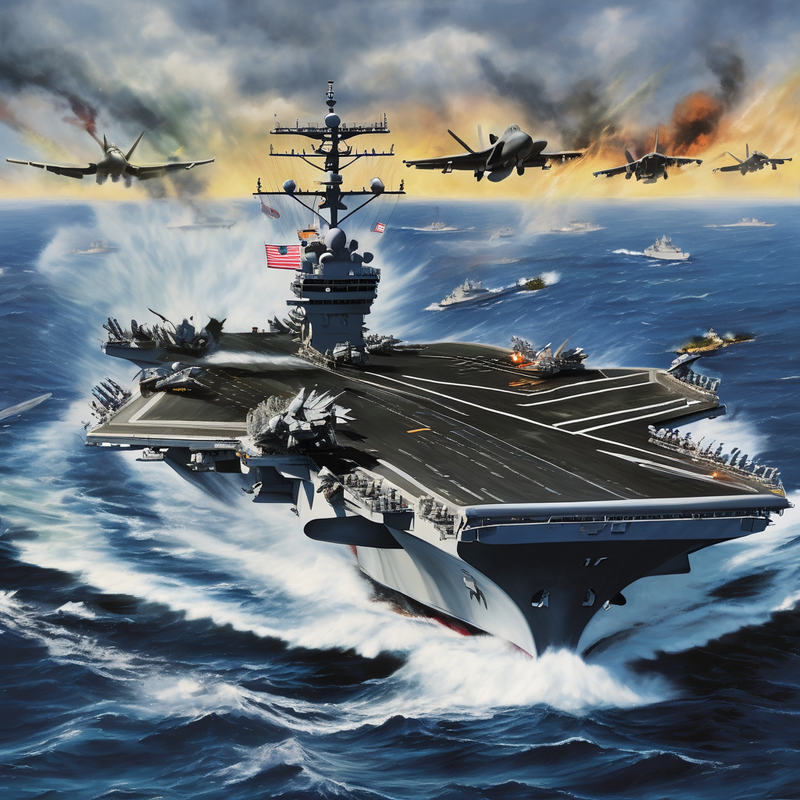
Pentagon Sends Aircraft Carrier to Latin America as Trump Signals Escalation ✈️🌎
In an announcement that evokes both historical echoes and contemporary anxieties, the Pentagon has ordered the USS Ronald Reagan, a nuclear-powered aircraft carrier, to navigate southward towards Latin America. This decision comes on the heels of former President Donald Trump’s incendiary remarks, suggesting a potential military escalation in the region. It’s a move that could be likened to a chess player advancing a knight—strategic yet fraught with implications. But one must wonder: in this era of digital diplomacy and Twitter storms, is military posturing still the favorite gambit for U.S. foreign policy? 🤔
A Carrier’s Tale: Historical Context
The deployment of an aircraft carrier to Latin America is not merely a naval maneuver; it taps into a convoluted tapestry of U.S.-Latin American relations. From the 1823 Monroe Doctrine, which proclaimed the Americas off-limits to European colonization, to the “Gunboat Diplomacy” of the early 20th century, the U.S. has often wielded military power as both a shield and sword. Today, parading an aircraft carrier in the Caribbean serves as a stark reminder that some historical legacies refuse to fade, standing as sentinels over the evolving geopolitical landscape.
This latest mission stands in stark contrast to the stated goals of diplomacy and partnership often espoused by U.S. leaders. It seems that while the world pivots to discussions of trade agreements and climate change, Washington still holds a tattered, heavy tome titled “Military Solutions: A Practical Guide.” 📚
Escalation: Consequences and Considerations
What does this mean for the relationship between the U.S. and its southern neighbors? As the carrier sails closer to the coastlines of Latin America, murmurs of distrust may ripple through diplomatic channels. Is this display of military might a necessary deterrent against rising influences—be it from regional powers, rogue states, or even external actors like China and Russia? Or is it an outdated relic, more likely to engender resentment than allyship?
Herein lies the irony: the very presence of military power designed for protection may instead provoke the kind of instability it seeks to mitigate. With leaders in Latin America advocating for regional autonomy, the arrival of a U.S. warship might feel less like a safeguard and more like a cloud full of unresolved tensions—looming ominously over diplomatic efforts.☁️
Bridging the Gap: Diplomacy Amidst Military Might
In the shadow of booming military displays, how can the U.S. create a new narrative that promotes collaboration rather than conflict? Turning to soft power, a term applied generously by the likes of Joseph Nye, may hold the answer. Addressing pressing issues such as economic inequality, climate change, and public health could lay the groundwork for healthier relations. However, this is where a striking antithesis surfaces. While ships symbolize power, the true strength of a nation lies in its ability to build robust relationships based on mutual respect and understanding, as fragile as glass yet far more durable than steel.
American influence shouldn’t be about flexing military muscles but rather about sharing knowledge, culture, and resources. The true essence of diplomacy mirrors the characteristics of a well-tended garden: nurturing, patience, and encouraging growth in a shared ecosystem—one that doesn’t regard economic or military power as the primary measures of strength. 🌱
Painting a Future: What Lies Ahead?
As the USS Ronald Reagan preps for deployment, we are thrust into a stark reality loaded with implications for the region and beyond. What becomes of the conveyor belt of arms, the perpetual tug-of-war over influence, and the fragility of international agreements? Will this deployment usher in a cascade of military interactions across the continent, or can diplomatic overtures coexist with show of strength?
Perhaps the request is simple: a recalibration of strategy. While the aircraft carrier may serve as a brooding backdrop, the narratives forged on the land can be more compelling than any military posturing. Together it creates an image of balance—a tug of war between peace and war, progress and stagnation, the pen and the sword. ⚔️
In an era of heightened tensions, where the stakes feel palpably revived, reflecting on these dimensions might reveal that true strength often rests in the subtle exchange of dialogue rather than the thunderous roar of aircraft engines—a contradiction that the U.S. has yet to fully recognize. As we turn the page on this chapter, the much-needed question beckons: can we, at long last, learn from the past and harness the future differently? 🔄




Seems like the Pentagon is making a bold move with that aircraft carrier in Latin America. Wonder what the historical context has to say about it.
Wow, sending an aircraft carrier to Latin America seems intense. Is this a flex or a provocation? Hope it leads to meaningful dialogue.
Wow, sending an aircraft carrier to Latin America? Bold move or unnecessary escalation? What do you all think? 🤔🚢 #MilitaryDiplomacy
This move raises eyebrows! Is it a show of strength or a risky escalation? Lets discuss the implications. #militarypower #diplomacy
Interesting move. But is this really necessary? Will it escalate tensions or promote diplomacy? Lets discuss. 🤔🌎 #PentagonDecision
Wow, sending an aircraft carrier to Latin America? Bold move or unnecessary escalation? Whats your take on this military maneuver? 🤔🚢 #DebateTime
Wow, sending an aircraft carrier to Latin America? Is this a show of strength or a risky escalation? Lets discuss! 🤔 #militarypower #diplomacyvsforce
Why send an aircraft carrier to Latin America? Seems like a big move. Hope its for peaceful reasons! 🤔🛫 #diplomacyvsescalation
Wow, sending an aircraft carrier to Latin America? Thats a bold move. Wonder what the historical context is. Lets discuss diplomacy vs. military might!
Wow, sending an aircraft carrier to Latin America? Thats a bold move. Wonder what the historical context is behind this decision. 🤔🛫🌎