






Montgomery County Public Schools to Enforce Bell to Bell Cellphone Ban This Fall 📵🛎️
In an era where digital devices are as ubiquitous as oxygen, Montgomery County Public Schools’ decision to enforce a bell-to-bell cellphone ban might seem as antiquarian as stipulating quills over keyboards. Yet, here we stand, bewildered souls amidst our buzzing pockets, contemplating the earnest rationale behind this modern reconfiguration of classroom norms. Why this policy, and why now? 🤔
This mandate—to shield the young minds from their pocket-sized diversions—is not unprecedented. Across the globe, similar bans have been enforced, some greeted with vigorous applause, others with collective teenage eye-rolls. Yet, as the first bell rings, marking the strict onset of cellphone abstinence, we must ask: Is this reflective of a bygone era’s values, or a sagacious move towards re-emphasizing focus in education?
The Screen Zeitgeist and Its Discontents
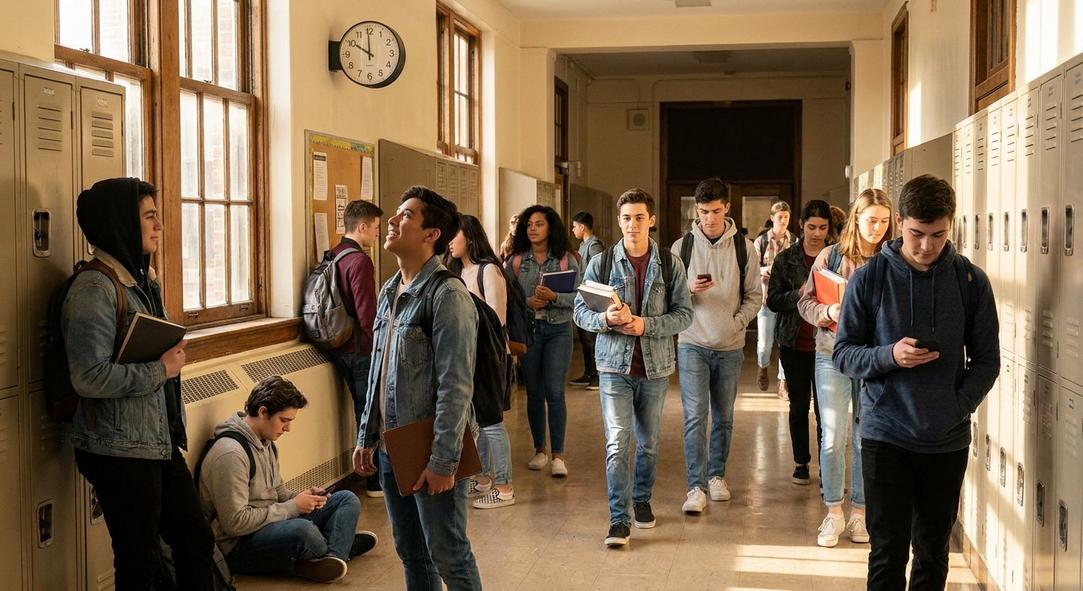
Picture the typical high school hallway: lockers line the walls like sentinels, students flit between classes, but more often than not, their peering eyes are fixed on their screens, each phone a miniaturized lighthouse distracting them from the palpable world. This spectacle, where the magnetic pull of screens outweighs the dull burden of textbooks, is precisely the paradox Montgomery County seeks to dissolve.
The essence of education has been interrupted, not by the diligent hum of learning, but by alerts, notifications, and a never-ending stream of digital chatter. Are we to blame technology, or instead, the lack of boundaries that allow it to perpetually supersede traditional learning? 📚
Dr. Agatha Hertzel, a psychologist specializing in adolescent behavior, suggests that “constant access to digital devices might impair a student’s ability to focus, akin to trying to listen to a whisper in the midst of a thunderstorm.” The challenge isn’t the availability of information; it’s distinguishing valuable whispers from incoherent noise.
A Clash of Epochs: Tradition vs. Modernity
The juxtaposition here is striking. On the one hand, we have the traditionalist cadence of the school bells, symbolizing structured, distraction-free learning. On the other, the unyielding allure of the digital epoch, promising limitless connectivity. Is banning cellphones an anachronistic endeavor clinging to the past, or is it a forward-thinking attempt to reclaim student attention? 🤓
- Academic Focus: A digital detox aims to restore concentration, with less time spent on Snapchat and more on calculus problems.
- Social Interaction: Encourages genuine face-to-face conversations and connections, which are becoming rare jewels in the digital age.
- Emotional Well-being: Reduces the pressure and anxiety associated with social media, comparison, and online personas.
Yet, opponents argue that this ban might ignore the educational benefits of technology, like instant information access and digital literacy. Are we, in our fervor, casting the proverbial net too wide, strangling positive digital usage in the process? 📱❓
Lessons from the Global Stage
Montgomery County is not alone in this initiative. Schools in France, China, and Italy have embraced similar bans, with varied success. In France, for example, the law prohibits cellphones to combat distraction and bullying, a policy embraced by some and criticized by others as over-cautious. Meanwhile, in the UK, schools boast a more moderate approach, permitting restricted use, like allowing phones during breaks and for educational purposes. 🌍🎓
A study by the London School of Economics found that schools with cellphone bans experienced a 6% increase in test scores, noteworthy chiefly among low-achieving students. However, nuances abound; another study highlighted how digital tools, when integrated thoughtfully, can enhance learning outcomes significantly.
The Balancing Act: Innovation versus Tradition
So, what do we tell Montgomery County’s students when the academic bell chimes, and phones retreat to silent oblivion? Is this draconian or a novel act of reclaiming the sanctity of undistracted learning? The answers lie entwined in a binary dance—not stark opposition but in the graceful integration of both instincts.
Whether this ban becomes a celebrated act of pedagogical reform or a fleeting gesture in educational policy, it undeniably sparks a vital dialogue on the role of technology in learning environments. Personal tales of disconnects—like those found while waiting for buses and not fearing one could miss an email at any second, for instance—add layers of lived experience to the larger debate. 📱🚫
Ultimately, perhaps it’s not about renunciation but recalibration—a harmonious merger where the clang of a school bell harmonizes with the hum of digital interactivity, crafting a symphony optimized for learning. For as the winds of pedagogical change blow, it is the skillful mariner who steers wisely, adapting rather than resisting the world’s inevitable currents. 🌬️🚀